
Self Help
-
What is tooth whitening?
Tooth whitening can be a very effective way of lightening the natural colour of your teeth without removing any of the tooth surface. It cannot make a complete colour change, but it may lighten the existing shade.
-
Why would I need my teeth whitened?
There are a number of reasons why you might get your teeth whitened. Everyone is different; and just as our hair and skin colour vary, so do our teeth. Very few people have brilliant-white teeth, and our teeth can also become more discoloured as we get older.
Your teeth can also be stained on the surface by food and drinks such as tea, coffee, red wine and blackcurrant. Smoking can also stain teeth.
‘Calculus' or tartar can also affect the colour of your teeth. Some people may have staining under the surface, which can be caused by certain antibiotics or by tiny cracks in the teeth which take up stains.
-
What does tooth whitening involve?
Professional bleaching is the most usual method of tooth whitening. Your dental team will be able to tell you if you are suitable for the treatment, and will supervise it if you are. First the dental team will put a rubber shield or a gel on your gums to protect them. They will then apply the whitening product to your teeth, using a specially made tray which fits into your mouth like a mouthguard.
The ‘active ingredient' in the product is usually hydrogen peroxide or carbamide peroxide. As the active ingredient is broken down, oxygen gets into the enamel on the teeth and the tooth colour is made lighter.
-
How long does this take?
The total treatment can usually be done within three to four weeks. First, you will need two or three visits to the dentist. Your dental team will need to make a mouthguard and will take impressions for this at the first appointment. Once your dental team has started the treatment, you will need to continue the treatment at home. This means regularly applying the whitening product over two to four weeks, for 30 minutes to one hour at a time.
However, there are now some new products which can be applied for up to eight hours at a time. This means you can get a satisfactory result in as little as one week.
-
What other procedures are there?
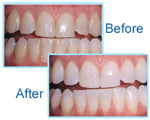
There is now laser whitening or ‘power whitening'. During this procedure a rubber dam is put over your teeth to protect the gums, and a bleaching product is painted onto your teeth. Then a light or laser is shone on the teeth to activate the chemical. The light speeds up the reaction of the whitening product and the colour change can be achieved more quickly. Laser whitening is said to make teeth up to five or six shades lighter.
-
How long does chair-side power whitening take?
Your dentist will need to assess your teeth to make sure that you are suitable for the treatment. Once it has been agreed, this procedure usually takes about one hour.
-
How much does tooth whitening cost?
Charges will vary from practice to practice and region to region. Laser or power whitening will be more expensive than professional bleaching. We recommend you get a written estimate of the cost before you start any treatment.
-
How long will my teeth stay whiter?
The effects of whitening are thought to last up to three years. However, this will vary from person to person. The effect is less likely to last as long if you smoke, or eat or drink products that can stain your teeth. Ask your dental team for their opinion before you start the treatment
-
What are the side effects?
Some people may find that their teeth become sensitive to cold during or after the treatment. Others may have discomfort in the gums, a sore throat or white patches on the gum line. These symptoms are usually temporary and should disappear within a few days of the treatment finishing.
If any of these side effects continue you should go to your dentist
-
What about home whitening kits?
There are many home whitening kits available, including paint-on whiteners and strips. How effective these are depends on the amount of whitening agent they contain.
Regulations on the sale of these vary from country to country and some of the products on the market are not effective. Always ask your dental team for advice before trying to whiten your teeth at home.
-
What about whitening toothpastes?
There are several whitening toothpastes on the market. Although they do not affect the natural colour of your teeth, they may be effective at removing staining. Therefore, they may improve the overall appearance of your teeth. Whitening toothpastes may also help the effect to last, once your teeth have been professionally whitened.
-
Can a single tooth which has been root filled be whitened?
Yes. Sometimes dead teeth go discoloured after a root filling. If the tooth has been root treated, the canal (which contained the nerve) may be reopened. The whitening product is applied from the inside to whiten the tooth.
-
When might tooth whitening not work?
YTooth whitening can only lighten your existing tooth colour. Also it only works on natural teeth. It will not work on any types of ‘false' teeth such as dentures, crowns and veneers.
If your dentures are stained or discoloured visit your dental team and ask for them to be cleaned.
-
How can I look after my teeth once they have been whitened?
 You can help to keep your teeth white by cutting down on the amount of food and drinks you have that can stain teeth. Don't forget, stopping smoking can also help prevent discolouration and staining.
We recommend the following tips to take care of your teeth:
- brush your teeth last thing at night and at least one other time during the day, with a fluoride toothpaste
- cut down on how often you have sugary foods and drinks
- visit your dental team regularly, as often as they recommend.
-
Why should I have orthodontic treatment?
Many people have crowded or crooked teeth. Orthodontic treatment will straighten the teeth or move them into a better position. This can improve their appearance and the way the teeth bite together, while also making them easier to clean.
Some people have upper front teeth that stick out and look unsightly. These 'prominent' teeth are more likely to be damaged, but orthodontic treatment can move them back into line. Or the way the upper and lower jaws meet can cause teeth to look unsightly and lead to an incorrect bite. Orthodontic treatment may be able to correct both of these problems.
When the teeth don't meet correctly, this can put strain on the muscles of the jaw, causing jaw and joint problems and sometimes headaches. Orthodontic treatment can help you to bite more evenly and reduce the strain.
-
At what age should I have orthodontic treatment?
The best time is generally during childhood, but adults can have orthodontic treatment too - and more and more are doing so. Age is less important than having the right number of teeth. In children it may be necessary to wait for enough teeth to come through before starting treatment.
-
Who carries out orthodontics?
Your dentist may carry out orthodontic treatment. Or they may send you to a specialist who has extra qualifications. The specialist may be in a practice or in a hospital department, and is called an orthodontist.
-
What does it involve?
The most important thing is to have a full examination. This will usually involve looking at your teeth, taking x-rays and making plaster models of your teeth.
Your dental team or orthodontist will then discuss what treatment is possible. Once you are sure you want to go ahead, the treatment can start as soon as you have enough permanent teeth.
-
Will I need to have teeth taken out to make room?
You may not have enough room for all your permanent teeth. If so, you may need to have some permanent teeth taken out to make space. Your dental team will tell you whether this is the case. Sometimes space can be made using other forms of treatment.
-
How is treatment carried out?
Orthodontic treatment can be done by many sorts of appliances, which most people call a 'brace'.
-
What is a removable brace?
Simple treatment may be carried out with a removable brace (a plate that can be taken out to be cleaned). It has delicate wires and springs attached, which move the teeth using gentle pressure.
-
What is a fixed brace?
Often, teeth need to be guided more accurately than they can be using a removable brace. So a fixed brace is used. This has brackets and bands which are temporarily stuck to the teeth. A flexible wire joins all the brackets and allows the teeth to be moved. You can't take the appliance out yourself, so it is called a fixed appliance.
-
What is a functional brace?
It is sometimes possible to change the way the jaws grow, using a functional brace. This works by using the power of your jaw muscles and can help with certain types of problem.
-
What are the brackets made of?
Fixed braces are not always made of metal. Plastic and ceramic can be used, especially for adults.
-
What is headgear?
As well as a brace some people need to wear headgear. You usually only need to wear it in the evening or at night. If you do not wear it in the way you have been told, your front teeth may stick out at the end of treatment.
-
What are 'invisible braces'?
They are tough, clear plastic 'aligners' (moulds) that are used to straighten teeth. Several sets of specially moulded, slightly different aligners are made for each patient. Each set is worn for two weeks before being replaced with the next one. They are made from clear plastic, so they are nearly invisible. This means that no one need know you are straightening your teeth.
The aligners should be worn for 22 to 23 hours a day for the best results. They can be easily removed for eating, drinking, brushing, and for cleaning in between your teeth. You need to have all your adult teeth before you can have this treatment.
-
What are elastics?
Sometimes delicate elastic bands are attached to a fixed brace to help move the teeth. Your orthodontist will tell you if you need elastics.
-
How long will it take?
The length of treatment depends on how severe the problem is, and it may take anything from a few months to two-and-a-half years. Most people can be treated in one to two years.
-
What happens when the teeth are in the right position?
When treatment is finished the teeth need to be held in position for a time. This is called the ‘retention' period, and the appliances that hold the teeth in place are called retainers.
The retainers hold newly straightened teeth in position while the surrounding gum and bone settles. The retainers can be removable or fixed, depending on the original problem.
-
Will it hurt?
All appliances may feel strange at first, and can cause discomfort. If the problem doesn't go away, the orthodontist may be able to carry out adjustments to help. Teeth are usually uncomfortable immediately after a brace has been adjusted, but this will settle.
-
How many visits will it take?
Orthodontic braces usually need adjusting every 4 to 6 weeks. Your orthodontist will tell you how often your brace will need adjusting.
-
How successful will it be?
Success depends on both the skills of the orthodontist, and the enthusiasm and helpfulness of the patient (and parents, if the patient is a child). It is important to follow any instructions given by the orthodontist and to go to any appointments you have with them.
The success of the treatment also depends on the commitment of the patient. For children's orthodontic treatment it is very important that the patient is as keen as the parent.
-
Can orthodontics damage my teeth?
Your teeth can be damaged if you don't look after them properly during treatment. The braces themselves will not cause damage, but poor cleaning and too many sugary foods and drinks can cause permanent damage to your teeth. Brackets, wires and braces can trap food and cause more plaque than usual to build up. So you need to clean your teeth and appliance very thoroughly.
-
Is orthodontic work permanent?
Even after retention, it is normal for minor tooth movements to happen throughout life. So no permanent guarantee can be given. However, it is unusual for teeth to alter enough to need more treatment.
-
How do I go about getting orthodontic treatment?
The first thing to do is to visit your own dental team and get their advice. Your dental team will know whether you need treatment and will make the necessary arrangements.
-
How do I care for my brace and teeth?
It is important to keep having your teeth checked by your dental team while you are having orthodontic treatment. You also need to take extra care of your teeth and mouth:
- Clean your teeth carefully every day, including between your teeth where you can. Braces are delicate and you need to make sure you clean them carefully so that they do not break. Your dental team will be able to show you the special techniques to use depending on the appliance you are wearing.
- Cut down on how often you have sugary foods and drinks. Avoid snacks and drinks containing sugars, and fizzy drinks. Also, sticky and hard foods may damage your brace.
- Brush your teeth last thing at night and at least one other time during the day. Use a mouthwash if you need to. Your dental team may recommend a stronger fluoride toothpaste, or perhaps a fluoride gel or mouth rinse, for you to use